


Page 16 - TT-TCCF_Annual_Report
P. 16
India has been experiencing an increasing burden of cancer, with
                  almost 2 million new cases every year. Most of these are detected
                  in  the  later  stages  leading  to  nearly  50%  mortality  rates.  The
                  problem of high incidence and late detection is aggravated by
                  various factors like shortage of infrastructure and skilled
                  manpower to treat the disease. The cancer care facilities are
                  concentrated mainly in the larger cities causing the patients and
                  caregivers to travel long distances and incurring high
                  out-of-pocket expenses.
                  To address this mounting burden of Cancer and with a vision to
                  transform Cancer Care in India with a comprehensive cancer care
                  model, Tata Trusts in 2017, set up Tata Cancer Care Foundation
                  (TCCF) (formerly Alamelu Charitable Foundation) to implement
                  the Cancer Care Programme. The primary objective was to address
                  critical challenges such as poor infrastructure, shortage of medical
                  experts, and late detection in a phased and systematic manner. The
                  Cancer Care Programme is anchored on a four-pillar Distributed
                  Cancer Care Model (DCCM). Its mission is to reduce mortality and
                  morbidity due to cancer through awareness, prevention and early
                  detection by providing quality and a ordable care closer to
                  people’s homes.”
                  TCCF has been setting-up the development of Cancer Care
                  facilities as per a step-down approach.
                  OVERVIEW                                                                                                                                                                In keeping with this principle, a distributed hierarchy of facilities is underway in 17 cancer hospitals (one L1, five L2s and eleven L3s) across
                                                                                                                                                                                          the State, H to spread the support. Accordingly, a distributed hierarchy of facilities has been and is being created, with 17 cancer hospitals,
                                                                                                                                                                                          comprising one L1, five L2s and eleven L3s spread across the State.
                  In Assam, the incidence of Cancer has been a growing threat and poses a significant healthcare challenge. The Indian Council of Medical                                  In April 2022, the Prime Minister inaugurated 7 cancer hospitals in Assam. The hospitals in Dibrugarh and Barpeta are Level 2 facilities and
                  Research (ICMR) reported a staggering 50317 cases in 2020, though the true number may be significantly higher. Tragically, 70% of these                                  Jorhat, Tezpur, Lakhimpur, Darrang, and Kokrajhar are Level 3 centres.
                  cases are detected at an advanced stage, intensifying the struggle of the patients against this formidable adversary. The scarcity of
                  essential infrastructure and skilled medical professionals to combat this challenging disease further adds to the complexity. The lack of                               An apex centre of 350 beds is being set up in Guwahati. This state-of-the-art facility will provide advanced medical services and will also
                  awareness casts a shadow over the region, as many are unaware of preventive measures. Moreover, the una ordability of privatised                                        serve as a hub for teaching, training, and research. Two L2 centres are underway in Silchar and Diphu.
                  healthcare providers adds to the financial hurdles of those seeking assistance in their battle against cancer.
                                                                                                                                                                                          To further improve access to quality cancer care facilities, the Prime Minister also laid the foundation stone for 7 cancer care hospitals at
                                                                                                                                                                                          Dhubri, Nalbari, Goalpara, Nagaon, Sivasagar, Tinsukia and Golaghat.
                                                                                        STRATEGISING AGAINST CANCER
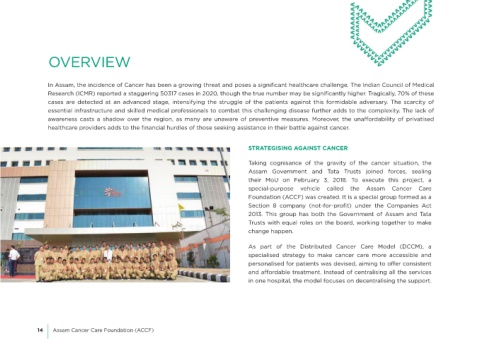
                                                                                        Taking  cognisance  of  the  gravity  of  the  cancer  situation,  the
                                                                                        Assam  Government and  Tata  Trusts  joined  forces,  sealing
                                                                                        their MoU on February 3, 2018. To execute this project, a
                                                                                        special-purpose vehicle called the Assam Cancer Care
                                                                                        Foundation (ACCF) was created. It is a special group formed as a
                                                                                        Section 8 company (not-for-profit) under the Companies Act
                                                                                        2013. This group has both the Government of Assam and Tata
                                                                                        Trusts with equal roles on the board, working together to make
                                                                                        change happen.

                                                                                        As part of the Distributed Cancer Care Model (DCCM), a
                                                                                        specialised  strategy to  make  cancer  care more accessible  and
                                                                                        personalised for patients was devised, aiming to o er consistent
                                                                                        and a ordable treatment. Instead of centralising all the services
                                                                                        in one hospital, the model focuses on decentralising the support.


              14   Assam Cancer Care Foundation (ACCF)

