


Page 72 - TT-TCCF_Annual_Report
P. 72
designated cancer hospitals, and empowering frontline healthcare providers at the community level through capacity-building initiatives.
                                                                                                                                                                                          Additionally, we facilitate inter-departmental coordination among the health, education, and police departments to ensure the seamless
                  OVERVIEW                                                                                                                                                                implementation of the National  Tobacco Control Programme (NTCP)  within the  districts. Furthermore, we engage with various

                                                                                                                                                                                          non-governmental stakeholders, including local civil societies, philanthropic organisations, self-help groups, and individual general
                                                                                                                                                                                          practitioners, to amplify the reach of our outreach activities.


                  The National Cancer Registry Programme projects an increase in
                  the number of cancer cases in the country to 15.7 lakh by 2025.
                  Additionally, 70% of these cases are reported in the later stages
                  of the disease, resulting in a high mortality rate ranging between
                  40-50%. In response to this significant public health challenge
                  posed by cancer, Tata Trusts initiated the Cancer Care
                  Programme in 2017. The fourth pillar of the Cancer Care
                  Programme is TCCF's outreach strategy. It is dedicated to
                  alleviating the burden of cancer through the early detection of
                  the disease, thus reversing the late-to-early detection ratio. This
                  pillar operates with a focused approach centred on four primary                                            Ranchi
                  objectives: spreading awareness about cancer risk factors,                                               Khunti
                  facilitating early detection, ensuring comprehensive follow-up
                  care for identified suspects and closing the loop and tobacco                          Chandrapur                     Saraikela
                  control.
                                                                                                                                   Bhubaneshwar
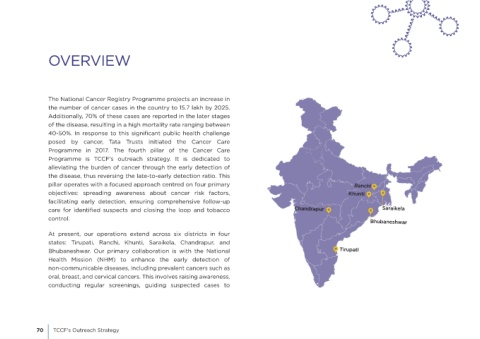
                  At present, our operations extend across six districts in four
                  states: Tirupati,  Ranchi,  Khunti, Saraikela,  Chandrapur, and
                  Bhubaneshwar. Our primary collaboration is with the National                                          Tirupati
                  Health Mission (NHM) to enhance the early detection of
                  non-communicable diseases, including prevalent cancers such as
                  oral, breast, and cervical cancers. This involves raising awareness,
                  conducting regular screenings, guiding suspected cases to


              70    TCCF’s Outreach Strategy

